Microzymas: The Life Forms that Rewrite the Rules of Reality with Dr. Marizelle Arce
Jan 20, 2026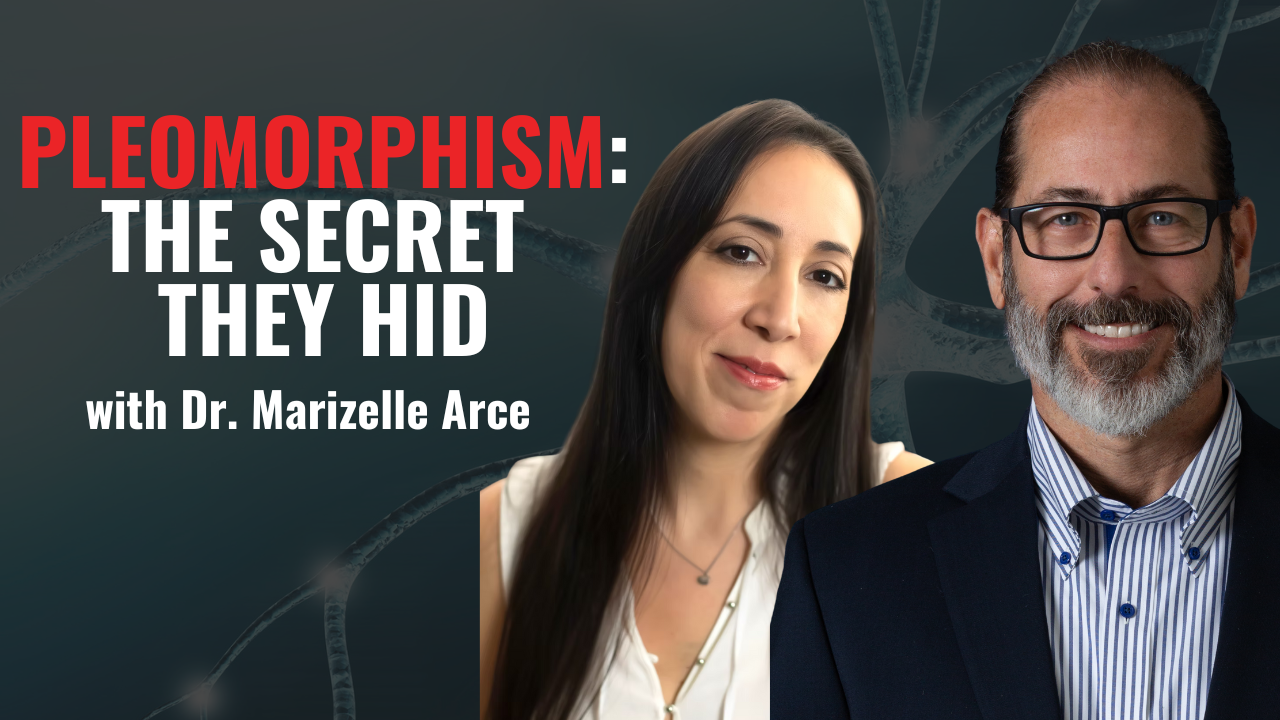
Are bacteria actually a mask worn by a shape-shifting life form? Dr. Marizelle Arce and Dr. Kaufman unravel the curious case of microzymas and pleomorphism.
Timestamps
00:00:00 - The secret basis of all life (they don’t want you to know about)
00:00:36 - Weaving the tapestry of terrain-based healing
00:01:46 - How Dr. Arce embarked on the path of true healing
00:17:09 - Unravelling the hidden reality of microzymas — and how they’re misconstrued as several strains of bacteria and fungi
00:24:50 - Observing microzymas under the microscope
00:33:50 - How the discovery of microzymas shatters the germ-theory of disease
00:40:58 - Homotoxicology: The unheeded hazards of suppressing “symptoms,” and why sickness is your body’s solution
00:47:16 - How to truly help your body heal (without getting in its way)
00:54:33 - What microorganisms — from the Staph on your skin to the yeasts on your wounds — indicate about your health
01:00:06 - How to learn more about Dr. Arce’s treasury of terrain-based wisdom
Links
Dr. Marizelle Arce’s complete breakdown of why germs are not your enemy (and what actually is): https://www.germsarenotourenemy.com/
Traverse Dr. Arce’s grand treasury of terrain-based wisdom: https://www.terraindoctor.com/
Transcript
Hello everyone, and welcome to The True Health Report. I’m your host, Dr. Andrew Kaufman, and today we’re going to explore key aspects of the terrain model with my special guest, Dr. Maricel Arce, author of Germs Are Not Our Enemy. It’s an excellent book written in a way that’s accessible to anyone, not just scientists. Dr. Arce is a naturopathic doctor with specialized expertise in pleomorphism and darkfield microscopy. We originally met through the Bigelsen brothers, collaborated on a panel about microscopic nanotechnology, and recently spoke together at the Terrainology conference. I wanted to bring her on to discuss these topics in greater depth. Welcome, Maricel.
Dr. Arce:
Thank you so much for having me. I’m really happy to be here.
Dr. Kaufman:
I’d love to start by having you tell the audience a little bit about how you found yourself on this path, especially since this was well before the pandemic. What led you into this area of medicine?
Dr. Arce:
I originally started in conventional medical school at New York Medical College, and I became very disheartened early on. I always wanted to be a doctor and help people. My earliest memories are of me as a little kid mixing crushed leaves and rocks on my driveway, trying to make potions to give to people. I genuinely thought I was making medicine. Historically, that instinct wasn’t far off, but modern medicine didn’t reflect that at all.
I grew up in a very multicultural household, primarily Peruvian. My grandfather lived with us for many years and taught me traditional ways of caring for the body—using lemon peels, broths, herbs, teas, and various natural preparations. That exposure made me deeply interested in anthropology and nutrition alongside medicine. When I entered medical school, I expected to see at least some acknowledgment of culture, environment, and context. Instead, medicine felt sterile, reductionistic, and disconnected from real human experience.
Patients were reduced to diagnoses and codes. Food, environment, community, and lived experience were almost irrelevant. That didn’t resonate with me. I didn’t believe we were simply bags of chemicals interpreted through lab reports, so I eventually realized I couldn’t continue down that path.
Dr. Kaufman:
Leaving medical school is a big decision. It takes a lot of courage. You’re already “inside the club” at that point.
Dr. Arce:
It does. I was fortunate to have a very strong, grounded mother. She encouraged me to keep searching and reminded me that the path shouldn’t feel this wrong. That led me to naturopathic medical school in Connecticut. While it wasn’t perfect and still had many of the same limitations, it exposed me to practitioners who thought more broadly about health. I realized I would have to make my education my own.
Dr. Kaufman:
That’s something I tell young people all the time. Institutions change over time and often prioritize self-preservation. Even alternative schools largely followed the same COVID rituals as mainstream medicine.
Dr. Arce:
Absolutely, and honestly, to a greater extent than I expected. Still, one of the pivotal moments for me came during microbiology lab. We were asked to culture environmental samples. I chose to swab my cellphone. When I examined the cultures grown at body temperature, I saw bacterial forms that didn’t fit conventional classifications. They weren’t cocci or bacilli. They were intermediate forms, shifting back and forth.
I reported this, and my professor assumed I had done something wrong. I repeated the experiment several times with the same result. Eventually, he repeated it himself and observed the same thing. He acknowledged that something unusual was happening but didn’t have an explanation for it.
Dr. Kaufman:
So even if there was an anomaly, the assumption was still error rather than questioning the model.
Dr. Arce:
Exactly. About a year later, I applied for a position with a company affiliated with Sanum remedies. As I reviewed their materials, everything clicked. They described pleomorphism—the ability of microorganisms to change form based on the environment. What I had seen in the lab suddenly made sense. I realized I hadn’t made a mistake. I had simply observed something outside the dominant paradigm.
Dr. Kaufman:
Why isn’t this taught?
Dr. Arce:
Because germ theory dominates medical education. Pleomorphism is treated as a historical footnote rather than a living biological process. Bechamp, Enderlein, Naessens—all documented these phenomena, but their work was sidelined.
Microzymas are submicroscopic, formless, colloidal protein structures that respond to their environment. What we call bacteria, fungi, or yeast are expressions of these microzymas under specific conditions. Bechamp believed they were the smallest unit of life, even smaller than the cell.
Dr. Kaufman:
And these entities have been found not only in living organisms, but also in inert materials.
Dr. Arce:
Yes. I’ve personally observed them in biochar. Under darkfield microscopy, you can see spark-like structures consistent with microzymal activity. Even in extreme conditions, they persist.
To observe them properly, you need live blood analysis using darkfield microscopy. Mainstream medicine relies almost exclusively on fixed, stained samples, which completely eliminates the ability to see dynamic processes.
Dr. Kaufman:
That explains why methylene blue, for example, produces such striking visuals but suppresses activity.
Dr. Arce:
Exactly. It kills red blood cells and halts movement. Many people feel relief when taking it, but that’s symptom suppression, not healing. Once blood leaves the body, it begins to decay. Watching that process under the microscope shows how microzymas respond dynamically to tissue breakdown.
Dr. Kaufman:
Which suggests that many microbes involved in disease and decomposition originate from within the body, not from external invasion.
Dr. Arce:
Correct. Microzymas respond to changes in pH, oxygen, nutrition, emotional stress, trauma, and toxicity. They can facilitate healing or assist in breakdown. Inflammation is part of that process. Suppressing it often pushes problems deeper.
This aligns with homotoxicology, where disease progresses as elimination pathways are blocked. Symptoms like sneezing, diarrhea, or rashes are attempts to expel toxins. When suppressed, the body escalates its response, eventually storing toxins in tissues.
Dr. Kaufman:
So microbes act more like indicators than enemies.
Dr. Arce:
Exactly. Streptococcus, for example, thrives in damaged tissue with microbleeding. Its presence tells us the tissue needs repair, not eradication. Supporting healing allows the organism to revert to simpler forms.
As terrain degrades, organisms shift from bacterial to mycobacterial to fungal and yeast forms, reflecting increasing oxygen deprivation and nutritional deficiency.
Dr. Kaufman:
This gives us a coherent, testable model of disease that actually explains what we see clinically.
Dr. Arce:
Yes. Once you understand that microorganisms are responding to terrain, healthcare becomes simpler, more humane, and far more effective.
Dr. Kaufman:
Thank you so much for this discussion. Where can people find your work?
Dr. Arce:
My book Germs Are Not Our Enemy is available on Amazon and through our website for bulk orders. You can also find me at TerrainDoctor.com and on Substack, where I write regularly.
Dr. Kaufman:
Fantastic. I encourage everyone to read the book and follow Dr. Arce’s work. We’ll definitely have to continue this conversation in the future.
Stay connected with news and updates!
Join our mailing list to receive the latest news and updates from Dr. Andrew Kaufman.