How Modern Cars Are Monitoring Your Every Move and How America Lost Its Inventive Spirit with Casey the Car Guy
Dec 05, 2025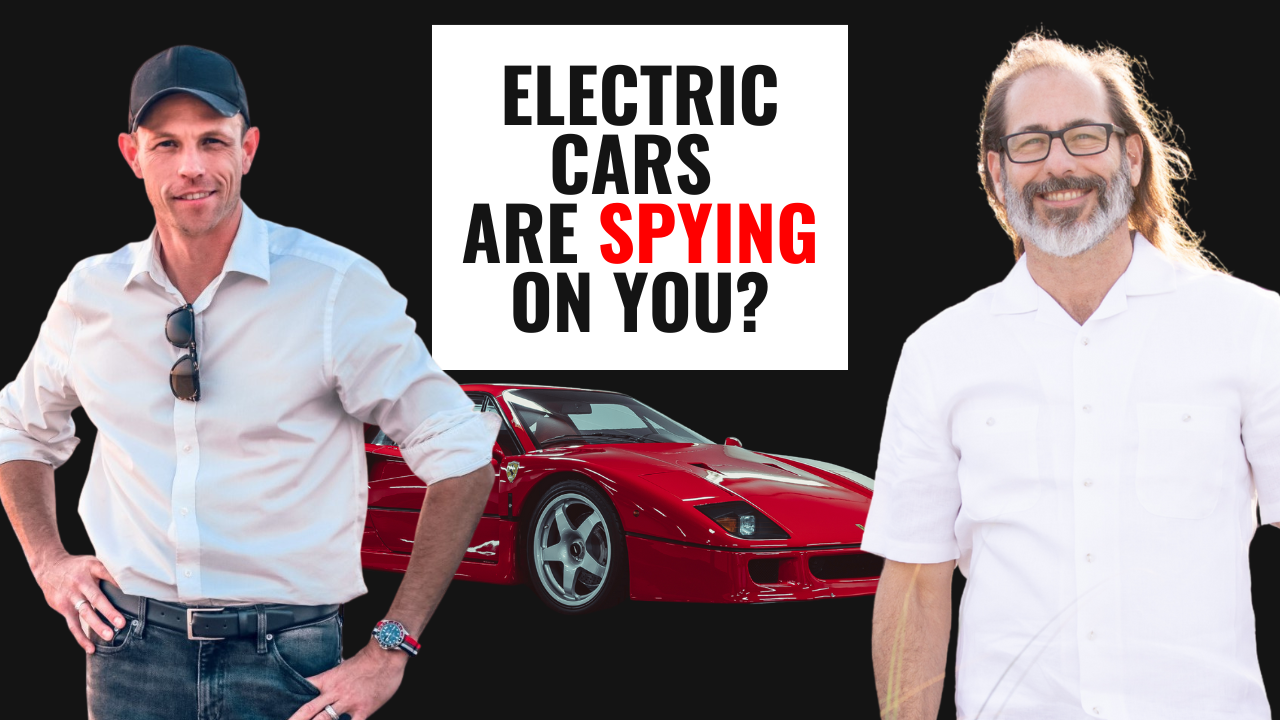
Electric cars aren’t saving the planet — they’re locking you into digital chains.
Let’s face it: who wouldn’t enjoy fueling their car while they're sleeping (for half the price of a full tank) and never having to deal with frequent oil changes or failing transmissions. Plus, we’re keeping the planet clean, right? Yeah, not really…
EVs are not as “eco-friendly” as we're taught to believe. In fact, they’re polluting our planet worse than your standard petrol sedan. But that’s not the only reason you should avoid buying one as if your life depends on it — because it actually might.
Just imagine, Covid-19 2.0 is upon us — you refuse to roll up your sleeve, spread “misinformation” on social media, or pay a visit to your crew of non-conformists during a curfew — and suddenly, your car isn’t starting…
The battery is working, your car is fully charged, and driver authentication was successful… Still, no answer. And suddenly, it strikes you — Big Brother locked you out of your car for speaking your truth.
But rest assured, because we don’t have to rely on the power grid to make cars sustainable and slave-labor-free.
The breakthrough that took my breath away was the Omega Car — With a capacity of 100mpg and a speed of 0-60 in 5 seconds — this has been the most sustainable supercar for over a decade. Which is why those up-high have actively been keeping it out of the public eye.
In this episode of the True Health Report, I’m inviting the inventor himself, Casey Putsch — aka Casey the Car guy, to expose why the world’s wealthiest power players are ignoring the Omega Car — and the grim purpose EVs actually serve.
Together, we explore:
- Why electric cars pollute our planet worse than the petroleum industry ever could
- How EVs are actually a surveillance state Trojan Horse designed to clamp down on your freedom
- How we build faster, cheaper, and more sustainable cars simply by using diesel and efficient designs
- How the public schooling has stripped away real problem-solving and eroded the self-reliance people once possessed
- How the world’s wealthiest power players have been funding America’s downfall — with BLM, LGBTQ, and Antifa serving as small pieces in a large, strategic game
Tune in then share your thoughts!
Timestamps
00:00:00 - How electric cars are quietly stripping away your freedom
00:01:02 - The drive that opened Casey’s eyes
00:06:53 - How cars shifted from being symbols of freedom to instruments of control
00:13:28 - The blueprint for building the most sustainable supercar (that’s not electric)
00:28:06 - Why real problem-solving and the self-reliance people once possessed completely vanished
00:33:21 - The downfall of American culture (and how the world’s wealthiest power players played a part in it)
01:00:30 - Looking beyond the veil of political polarization and how we realize a freer reality
01:06:47 - What’s next for Casey the Car guy?
Links
Casey’s stunning archive of videos on cars and common sense:
https://www.youtube.com/@CaseyPutsch
Support Casey in his mission to kick start young bright minds’ careers and foster the hands-on experience public schooling refuses to teach: https://geniusgarageracing.com/
Transcript
Casey:
Electric vehicles don’t just change how we power cars—they change who controls them. Once a car is connected to the internet, it can be monitored, limited, shut off or even directed in real time. With self-driving technology, we’re only half a step away from cars literally dictating where you go and when. Modern vehicles are becoming a physical extension of the algorithm. At what point do they choose your route, your timing, and your destination? That kind of control erodes the freedom of individuals, communities, and society. It centralizes power in the hands of global elites and the politicians aligned with them.
Dr. Kaufman:
This is The True Health Report, where critical appraisal fuels true freedom. Welcome back, everyone. I’m your host, Dr. Andrew Kaufman. Today’s guest is someone a little different from our usual lineup. You might know him from his large automotive YouTube channel—Casey, “the car guy.” But in recent months he has shifted dramatically, taking risks and facing censorship to speak openly about what’s happening in our society. I wanted to bring him on to discuss that shift, his insights, and where this all leads. Casey, welcome to the podcast.
Casey:
Thank you. I’m honored to be here and ready to go—fire away.
Dr. Kaufman:
Great. I want to begin on a lighter note. You grew up in a working-class family, helping run a public golf course, doing everything from fixing diesel mowers to managing events. At what point did cars become such a central passion for you, and how far have you taken that beyond YouTube?
Casey:
Growing up in Tiffin, Ohio, our family ran an 18-hole public golf course with a banquet facility. We worked constantly—my father from 6 a.m. to 10 p.m. during the season, and in the off-season we hosted weddings, reunions, big events. We weren’t just wearing polos at the pro shop; we were welding mowers in the field, repairing equipment, mowing, handling customers, strategizing the business—everything.
It exposed me to every kind of person: blue-collar workers grabbing a six-pack to play golf, all the way to doctors and lawyers. That upbringing taught me responsibility, work ethic, and how to interact with thousands of people. My dad was into cars—had a Corvette Roadster, a Model A, a Morgan. We worked on them ourselves. We also loved slot cars and RC cars. Some of my best memories were the rare day trips to Mid-Ohio Sports Car Course because we could never take real vacations. That’s where my love for cars really cemented.
Cars also hold onto culture. So many things from our past disappear—businesses, homes, traditions. But a car from 1985 can still feel like 1985. You can sit in a Porsche 944, listen to the music, and be transported back. Cars contain memories.
Dr. Kaufman:
I agree. Racing and driving have been meaningful parts of my own life too. Cars have always symbolized freedom—hitting the open road. But today, much of that feeling is turning into nostalgia.
Casey:
Well, not entirely. We still can drive our cars. For example, the orange Murciélago behind me—took me my whole life to get it. When I first drove it, I remember thinking, “They can pry this from my cold, dead hands. This is the last bit of freedom.” That feeling is still real.
Dr. Kaufman:
Fair point. But the auto industry has changed dramatically—mandates, “climate change” regulations, the surveillance aspects of modern cars, and the declining durability of new models. What’s your take on what’s happening?
Casey:
Electric vehicles were barely a blip in the 90s. But fast-forward into the Biden administration and states like California: sweeping mandates requiring huge percentages—or all—new cars sold to be electric by certain dates.
I have major problems with that. It’s government-directed industrial control—a mechanical component of fascism. When you force everyone into one power source and one infrastructure, you destroy innovation. EVs are not the green miracle people think they are. Manufacturing them is massively energy-intensive and toxic, especially the batteries. It can take around 100,000 miles before an EV “breaks even,” and even that number is optimistic.
Dr. Kaufman:
Right—and extracting rare earth metals requires heavy diesel machinery, which isn’t exactly green.
Casey:
Exactly. And that’s without touching on the human rights issues in cobalt mining operations in places like the Congo. It reminds me of 20,000 Leagues Under the Sea—the slave mines Captain Nemo escaped from. The situation today is no less disturbing.
But the point is this: the environmental narrative is a cover. It’s not really about climate. It’s about controlling power, industry, and people. Electric cars can be monitored and remotely limited. Self-driving adds another layer of control. Cars become tools of enforcement.
Dr. Kaufman:
You’re saying the push wasn’t environmental—it was political.
Casey:
Correct. It’s power consolidation dressed up as virtue.
Back in 2008, Obama promised to “help Detroit retool” for efficient cars. I knew it was nonsense. After the financial crisis, the government bailed out GM—yet nothing changed. They doubled down on trucks and muscle cars.
Meanwhile, I started researching how we could build extremely efficient cars—cheaply and cleanly. And eventually I decided to do it myself. That’s how the Omega Car was born.
It’s a two-seat, mid-engine, diesel commuter car designed to be mass-produced for about $20,000, with over 100 mpg and 0–60 in under five seconds.
Dr. Kaufman:
A mid-engine car at that price is already amazing.
Casey:
It’s not hard when you design intelligently. Most people commute alone. So make a small, aerodynamic, lightweight car that's actually fun to drive. It has to be efficient and cool—otherwise nobody wants it.
My very first test run: 104.7 miles per gallon. No tuning, no aerodynamic fairings.
Then I tested 0–60 against my Dodge Viper, a Corvette Grand Sport, and a Tesla Model 3. My car beat the Viper, matched the Tesla and Corvette—on worn 12-year-old tires. And it still achieved over 100 mpg.
Then I compared carbon footprint per mile using the EPA’s own numbers. My car produces less carbon per mile than an EV charged at home—and it's cheaper to operate.
Because diesel infrastructure already exists. You don’t need to build anything new.
Dr. Kaufman:
And you’re using their numbers, not your own.
Casey:
Exactly. Their math supports my conclusion.
So the debate isn’t EV vs. gas. It isn’t left vs. right. It’s:
What actually works? What helps people? What’s good engineering?
I can use the same design principles to build 4-door cars, light trucks, even heavy trucks. We could have an efficient, affordable, low-pollution automotive industry right now.
But political mandates don’t allow innovation outside their chosen lane.
Dr. Kaufman:
People have tried building super-efficient cars before, but they often get suppressed or bought out.
Casey:
Yes—and sometimes they disappear entirely. Historically, big oil crushed these ideas before the internet existed. Today, corporations and governments do it indirectly through regulations.
I built the Omega Car not just to innovate, but to make a political, economic, and social point.
To show that the narrative is false.
To show options exist—better ones.
Dr. Kaufman:
The engineering sounds sophisticated. Did you design the engine from scratch?
Casey:
No—the engine is a Volkswagen 1.9 TDI from the early 2000s. Old, simple, efficient, reliable. Mine already had 132,000 miles when I started. The magic isn’t the engine—it’s the car. Aerodynamics, weight, design, chassis, efficiency. That’s what modern car companies fail at.
Most cars today are heavy, draggy steel boxes with unnecessary components. Even side mirrors create drag—modern tech could replace them. Efficiency requires creativity and clean-sheet thinking. But the system doesn’t reward that.
Dr. Kaufman:
So innovation isn’t hard—our systems just suppress it.
Casey:
Exactly. Our educational system crushes creativity. Corporations use universities as idea farms. Students go into debt, their ideas get harvested, and they enter the workforce already drained.
And government “support” systems are traps. Take your experience—you had a promising medical device idea, and the institution claimed ownership. Then the state taxed your grant. The whole system discourages innovation.
Dr. Kaufman:
Agreed. So when did this all crystallize for you? When did you decide to speak out publicly?
Casey:
Over years—annoyances, injustices, watching corruption. But the last few years pushed me over the edge. The culture shift, political absurdity, the censorship. I felt compelled to contribute something meaningful.
I considered running for Congress. I was urged into political circles in Washington. I explored it. Ultimately, I saw the system from the inside and realized it was rotten.
So instead, I spoke out directly.
I tested the Omega Car, released videos explaining why I supported Trump at the time, criticized EV mandates, and exposed political corruption. Then someone gave me Tucker Carlson’s number. I cold-texted him. He replied. Next thing I knew, I was on his show.
My episode became the most viewed video on his entire YouTube network—surpassing even Putin interviews.
Dr. Kaufman:
That’s impressive—you even beat the guests you were bumped for.
Casey:
Apparently so. But what mattered to me wasn’t fame. It was that ordinary people resonated with the truth.
But I also saw the dark side. Investors contacted me, but every single one seemed interested only in extracting value—not building something. When they realized I couldn’t be exploited, they vanished.
That angered me deeply.
Millions of views, undeniable results—and zero real support from industry, government, or institutions.
That was a wake-up call.
Dr. Kaufman:
It sounds like you reached a breaking point.
Casey:
Yes. I realized:
There is no future for real innovation in this system.
No accountability.
No support for those trying to build value.
We’re in a cage. And there is no path forward unless we fight.
America’s political parties have both abandoned their promises. I’m done with the left-right divide—they’re two wings of the same corrupt bird. Now I call out everyone.
If someone wants to cancel me, threaten me, attack me—fine. I no longer care. There’s no future unless people stand up.
Europe is collapsing into authoritarianism. So is the U.K. Germany is suffocating under propaganda. The West is falling. Where can an honest person go to build something meaningful?
Dr. Kaufman:
Do you think the elites coordinate, or are they acting individually?
Casey:
It’s not a single smoky back-room meeting. It’s game theory—the Prisoner’s Dilemma. Corruption incentivizes corruption. If one politician plays dirty and wins, others must follow or lose. With lobbying and no term limits, the system reinforces itself.
And social media accelerates deception over cooperation. It creates shortcuts that reward manipulation, not collaboration.
We’ve become a society where wealth comes from extraction—pump-and-dump schemes, private equity, artificial inflation—not creation.
That kills innovation.
Dr. Kaufman:
And the effects ripple out—towns, families, culture, everything suffers.
Casey:
Exactly. I watched my hometown decline. The family golf course—decades of culture—was destroyed after the 2008 financial crash eliminated lending. It was sold for a song, mismanaged, then bulldozed into raw land. All the memories, nature, wildlife—gone.
People haven’t changed. They want families, community, stability. It’s politicians and financiers destroying those things.
I’ve spent my life building—education programs, engineering nonprofits, efficient cars. And yet the system supports none of it. Meanwhile, corrupt politicians get rewarded.
I’m tired of watching America deteriorate while people are silenced.
Dr. Kaufman:
Your political videos have gotten a huge reaction—people across the spectrum are agreeing with you.
Casey:
Yes. Conservatives, liberals, Californians, everyone. The anger is boiling over. People know the system is failing.
But no influencer is stepping into the leadership void with lived experience, integrity, and courage. So I’m doing it myself. Gloves off. Full truth.
Dr. Kaufman:
As we close—how do we move forward? What can individuals do?
Casey:
First: it’s okay to be angry. But it has to be controlled and applied intelligently.
We can’t sit out of politics. If we disengage, the worst people take total control. Government is supposed to be for the people, by the people—not a place for insider trading and power accumulation.
We need genuine candidates. We need citizens who think critically and see through propaganda. We need cooperation instead of manufactured division.
The left-right divide is fake. It’s engineered to keep us weak. The government cycles through divisive narratives—race, gender, identity, immigration, now antisemitism—to pit Americans against each other.
If we recognize the manipulation, we break its power.
We have far more in common than we’re told.
Dr. Kaufman:
Awareness itself dissolves the spell. And I think most people agree on the basics of right and wrong when the noise is stripped away. For those who want to support your work—the Omega Car or the nonprofit—how can they find you?
Casey:
A simple search of my name—Casey Putsch, spelled P-U-T-S-C-H—leads to everything. The Omega Car, Genius Garage, my YouTube channel. Genius Garage is a 501(c)(3) educational charity; the smallest donation helps students immensely. For the Omega Car, people can email me—I'll be expanding that project soon, including opportunities for small sponsorships.
And of course, subscribe to my channel. Things are about to get even spicier. I want all of us thinking critically and working together—and if I ever miss the mark, I want people to call me out. I'm here to cooperate, not tear down. But if someone tries to take me out—
Get ready for a fight.
Dr. Kaufman:
I encourage everyone to subscribe to Casey the Car Guy on YouTube. If nothing else, you’ll want to see what he says next. Casey, thank you for this incredibly passionate and insightful conversation.
Casey:
I’m honoured. Thank you for having me.
Stay connected with news and updates!
Join our mailing list to receive the latest news and updates from Dr. Andrew Kaufman.