Sidestepping the Surveillance State with Hakeem Anwar
Dec 23, 2025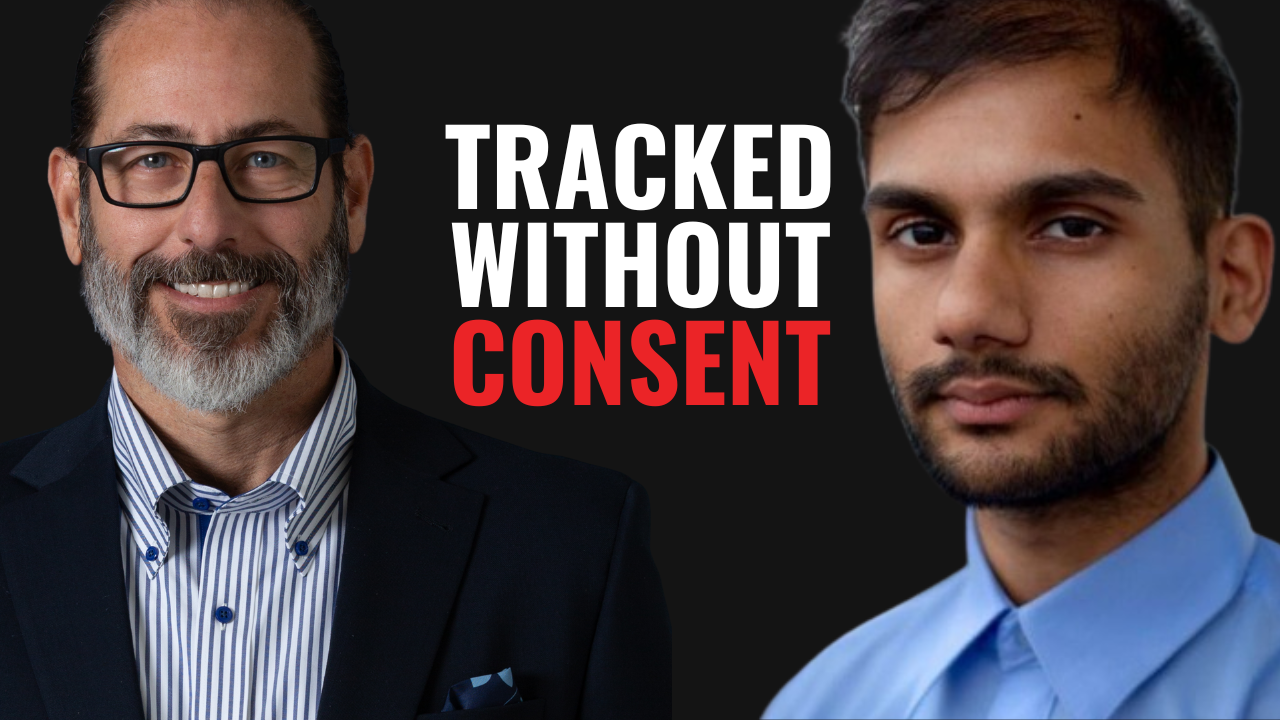
How Big Tech Sells You Surveillance Disguised as Convenience.
The formidable phrase “Big Brother is watching you” from the cult-classic novel 1984 is no longer just a vestigial catchphrase. It has become our everyday-reality…
However, rather than seeing posters with INSOG’s insignia and Big Brother’s grim face staring right into your soul, you’re being enticed with the brand-new Iphone 17 and its “iCloud Sync” and continuity features.
Thus, instead of forcing telescreens down your throat, Big Tech is selling you its surveillance as safety, convenience, and fashion.
And surely, you’re told that you can simply “switch off” your behavioural and usage tracking, location services, or simply put your phone on Airplane mode. But here’s what they’re not telling you…
Both iOS and Android are still sending your personal data straight to Apple & Google every 5 minutes, regardless of whatever you turn off.
So should you just throw your $1000 Iphone in the bin?
Yes… Absolutely. But that doesn’t mean you shouldn’t own a phone, laptop, or tablet at all.
The good news is: you don’t have to become a luddite, use carrier pigeons, and switch to paper maps…
You can rejoice in the perks of modern technology, without being spied on and having to capitulate to Big Tech sharing all of your private data… .
That’s where Above Phone comes in, and its founder, Hakeem Anwar, is joining me on the True Health Report to show you how to sidestep the surveillance state and safeguard your privacy from the clutches of malevolent databrokers and databases.
Together, we explore:
- Why most modern smartphones are surveillance devices disguised as fashion
- Effective solutions to counter the encroaching surveillance state that you can start applying in your life today
- The major Digital ID pitfalls that get you hooked to the control grid (that most are unaware of)
- How IGOs compel foreign nations to comply with Digital ID benchmarks
- A step-by-step guide to harnessing Hakeem’s fully encrypted and liberating laptops, phones and tablets
Tune in then share your thoughts!
Timestamps
00:00:00 - Total Information Awareness: how Big Tech is monitoring your every move
00:00:40 - The day Hakeem withdrew his technical prowess from the corporate machine and started helping people dodge the digital dictatorship
00:11:49 - How surveillance was sold to us as safety and who’s actually responsible for the infringement of our rights
00:16:18 - Big Tech’s digital doorways into your private data
00:28:14 - How you’re quietly consenting to Digital ID — and how to dodge it
00:35:17 - How your phone is spying on you and the settings — that are ‘on’ right now — that give it permission to
00:40:34 - Above Phone: breaking down the solution to the fourth industrial revolution
01:05:42 - Preparing for what comes next
Links
Explore Hakeem’s most unveiling insights on the future of technology (that Big Tech doesn’t want you to know about): https://takebackourtech.org/
Use technology that doesn’t use you with Above Phone: http://abovephone.com/drkaufman/
Transcript
Dr. Andy:
Hello everyone, and welcome to the True Health Report. I’m your host, Dr. Andrew Kaufman. Today’s conversation touches on technology, surveillance, and the world we’re living in now. Some of these topics can feel heavy or even unsettling, which is why the second half of this discussion focuses on solutions. That’s where the hope and optimism come in, so I encourage you to stay with us.
I first came across today’s guest, Hakeem Anwar, through interviews he did with Alex Eck and The Corbett Report. He’s created some excellent resources that I see as a meaningful part of the solution, which is why I wanted him here. He’s also someone from a younger generation who is actively working to build a better future—not just for himself, but for those who come after him. Hakeem, welcome to the show.
Hakeem Anwar:
Thanks so much for having me, Andy. I’m still getting used to calling you that, but I think titles matter a lot less than mutual respect. I really appreciate being here.
Dr. Andy:
I agree. Hierarchy isn’t really the point. Experience and potential balance each other out, and what matters is honest dialogue. I’m curious—how did you end up focusing your work on technology, privacy, and surveillance instead of taking a more conventional path?
Hakeem Anwar:
I’ve always been a bit of a black sheep. I started using computers at a very young age and eventually built a career as a software engineer, developing websites, mobile apps, and platforms while living in New York City. On paper, everything looked perfect—status, money, opportunity, and the usual path toward big tech companies like Google or Facebook.
But even before 2020, I was already questioning the system. I’d been researching topics that most people would dismiss as fringe. When the lockdowns hit, I watched New York unravel almost overnight, and something really clicked for me. I realized I didn’t want to spend my life helping to build what felt like a digital prison around myself. I left the city and reconnected with people who were already building outside mainstream structures, including those involved with the Freedom Cell Network.
While helping build a freedom-oriented social platform, I saw firsthand how powerful—and dangerous—data and digital connection could be. It became clear to me that even people trying to take control of their health and lives were still relying on corrupted technology. That realization became my mission. I started educating people through an initiative called Take Back Our Tech, teaching practical skills like installing Linux, choosing privacy-respecting software, and understanding how surveillance actually works instead of treating it like some abstract fear.
Dr. Andy:
You mentioned earlier that you went down a lot of rabbit holes. How did that begin?
Hakeem Anwar:
It started in college through chance encounters with mentors who introduced me to ideas like the military-industrial complex, the medical-industrial complex, and the hidden structures behind global systems. Once I was ready to see it, my entire worldview shifted. I didn’t really fit in at work anymore, and for years I lived a kind of double life—participating in the system externally while rejecting it internally.
Everything changed during the lockdowns. In some places, fear dominated everyday life, while in others people continued living relatively freely. That contrast showed me that alternatives were possible.
Dr. Andy:
A lot of people recognize those truths but feel trapped by their careers. You chose to fully align your work with your values. What did that cost you?
Hakeem Anwar:
Honestly, the cost was high. My family thought I was crazy. Friends couldn’t understand why I’d walk away from a lucrative career. I moved back in with my parents and lived between two worlds for a long time. Eventually, after speaking openly about corruption in big tech and government, I was effectively blackballed from returning to that industry. At that point, there was no going back. I had to build something new. It took years of uncertainty, but once I committed fully, doors started opening.
Dr. Andy:
That’s the reality of entrepreneurship, especially when truth and freedom are involved. Building a privacy-focused platform must have given you insight into how data gets corrupted.
Hakeem Anwar:
Absolutely. Once you see censorship, de-ranking, hacking attempts, and coordinated resistance, the pattern becomes obvious. That pushed me to research the origins of major platforms like Facebook and their connections to government surveillance initiatives.
Projects like Total Information Awareness and Sentient World Simulation were designed to track and model human behavior on a massive scale. Whether or not those projects were fully realized, modern tools—AI, big data platforms, and companies like Palantir—reflect the same underlying philosophy.
Private companies can bypass constitutional protections by partnering with government agencies. That enables warrantless surveillance through cameras, data-sharing agreements, and predictive policing. Systems like Palantir’s Gotham can integrate traffic cameras, police records, public databases—virtually any data source available through private contracts.
Dr. Andy:
What about license-plate readers and similar systems?
Hakeem Anwar:
Those are everywhere now—parking lots, neighborhoods, entire cities. They don’t just log plates; they track vehicle details, movement patterns, and associations. Facial recognition could easily be added. There’s no technical barrier—only decisions about optics and deployment.
The surveillance infrastructure is expanding rapidly, while legal and social norms lag behind. Destroying cameras isn’t the answer. The system adapts. The real solution is understanding what’s happening and opting out where possible.
Dr. Andy:
That brings us to digital ID.
Hakeem Anwar:
Digital ID becomes inevitable once biometric data and legal identity are linked. It’s already happening through airports, banks, and so-called convenience programs. It’s often rolled out through private-sector mandates rather than explicit laws, which makes resistance harder.
Devices themselves are central to surveillance. Phones and laptops increasingly default to cloud storage, AI analysis, and constant data extraction. Even privacy settings often amount to security theater. Wi-Fi positioning systems now track location with extreme precision, even indoors. Metadata alone can reveal military movements, population displacement, and social behavior.
Dr. Andy:
So what do people actually do?
Hakeem Anwar:
That question led me to found Above in 2021. We build phones and laptops using open-source operating systems designed to minimize data leakage, remove dependence on Google and Apple, and give users real control over permissions.
Our phones work worldwide with standard SIM cards or eSIMs. Users can isolate apps into separate profiles, replace insecure calls and texts with encrypted messaging, and sync messages securely across devices. The goal isn’t perfection—it’s informed consent.
Most apps today contain dozens of third-party trackers. We help people see what apps are actually doing and offer open-source alternatives whenever possible. The same applies to cloud storage and collaboration. Centralized platforms create enormous risk, but local-first and encrypted alternatives exist.
Dr. Andy:
Any final thoughts for listeners?
Hakeem Anwar:
A lot of modern technology feels like a weapon turned against people, but it doesn’t have to be that way. These tools can be reclaimed. The real value isn’t in harvested data—it’s in human relationships and resilient communities. If we’re intentional, we can build systems that actually reflect our values.
Dr. Andy:
Thank you, Hakeem. This has been an incredibly informative and practical conversation. I appreciate the work you’re doing, and I know our audience will too.
Stay connected with news and updates!
Join our mailing list to receive the latest news and updates from Dr. Andrew Kaufman.